How HG Automation Built a Multi-Patent, ISO9001-Certified Assembly Machine Platform: A 10-Year Engineering Timeline
YUYAO, ZHEJIANG, CHINA, October 20, 2026 /EINPresswire.com/ -- Manufacturing leadership rarely emerges from a single
Press Release Disclaimer: This is a press release distributed through the XPR Media network. It has not been independently verified by our newsroom.

YUYAO, ZHEJIANG, CHINA, October 20, 2026 /EINPresswire.com/ — Manufacturing leadership rarely emerges from a single breakthrough. More often, it builds through a series of deliberate decisions — about where to invest engineering resources, which problems are worth solving, and how to structure the relationship between a machine builder and the clients who depend on that equipment every day. The story of how Ningbo Huagong Automation Technology Co., Ltd. built a cross-industry assembly machine platform — spanning spray pumps, emulsion pumps, cap assembly, trigger pumps, and plastic parts — follows a decade-long accumulation of engineering decisions that are still visible in the structure of its products today.
Starting With a Problem Worth Solving
Huagong Automation was founded in Ningbo, Zhejiang — a port city embedded in one of China’s most concentrated manufacturing corridors. The timing and location were not coincidental. Across the daily chemical, cosmetics, and packaging industries clustered in this region, manufacturers faced a common set of pressures: rising labor costs, inconsistent assembly output, and production bottlenecks that off-the-shelf equipment could not resolve.
The founding premise was specific. A compressed timeline of key milestones: 2014 — founded in Ningbo, Zhejiang; 2018 — first patent certifications secured; 2020 — EU CE certification obtained; 2021 — ISO 9001 certification completed; 2024 — High-Tech Enterprise designation awarded. Each milestone expanded the addressable buyer base by removing a qualification gap that had previously limited international procurement approvals. Rather than producing general-purpose machines for a broad catalog, the company directed its early engineering resources toward non-standard automation solutions tailored to actual production environments. This focus shaped the R&D culture that followed — one oriented toward problem resolution rather than product volume.
Building Technical Depth Before Expanding Product Breadth
By 2018, Huagong Automation had secured multiple patent certifications. This milestone reflected something more significant than intellectual property protection. It documented an accumulation of verified engineering solutions — mechanisms, detection logic, and assembly architectures developed through real production challenges rather than theoretical design.
That technical foundation continued to deepen. In 2024, the company earned High-Tech Enterprise certification, a designation that requires documented R&D investment, qualified engineering personnel, and commercially applied proprietary technology. The certification did not create the engineering capability — it confirmed what had been building for a decade.
The Automatic Plastic Parts Assembly Machine (model HG-XSB01-4) illustrates how this depth translates into products. Running at 60 to 90 pieces per minute under fully automatic operation, the machine integrates PLC touchscreen control, whole-body self-inspection, and multiple safety protection functions within a compact footprint. It handles plastic parts assembly across cosmetics, daily chemical, and industrial goods applications — and carries an explicit design target of meeting European and American market standards. This is not an adapted catalog product. It reflects engineering maturity applied deliberately to a new problem domain.
From Single-Category Specialist to Cross-Industry Platform
Expanding a product range is straightforward. Expanding it with genuine engineering depth across fundamentally different application environments is considerably harder. Huagong Automation’s product evolution — from spray pump assembly machines through emulsion pump assembly, cap assembly, trigger pump assembly, and automated plastic parts assembly — spans daily chemical, cosmetics, food processing, toy manufacturing, and industrial goods sectors.
Each expansion required more than a new machine model. Different cap structures, pump geometries, and plastic component tolerances demand distinct feeding mechanisms, different detection logic, and calibrated assembly force parameters. A manufacturer without sustained engineering investment cannot maintain performance quality across this range. The breadth of the current product portfolio, therefore, serves as indirect evidence of the engineering infrastructure supporting it.
The company’s declared scope of business reinforces this point. Non-standard equipment development based on client-specific requirements, localization design of imported equipment, custom production line design and manufacture, and mechanical and electrical product design together describe an organization built for engineering complexity — not for catalog fulfillment.
What the Factory Layout Reveals About Manufacturing Standards
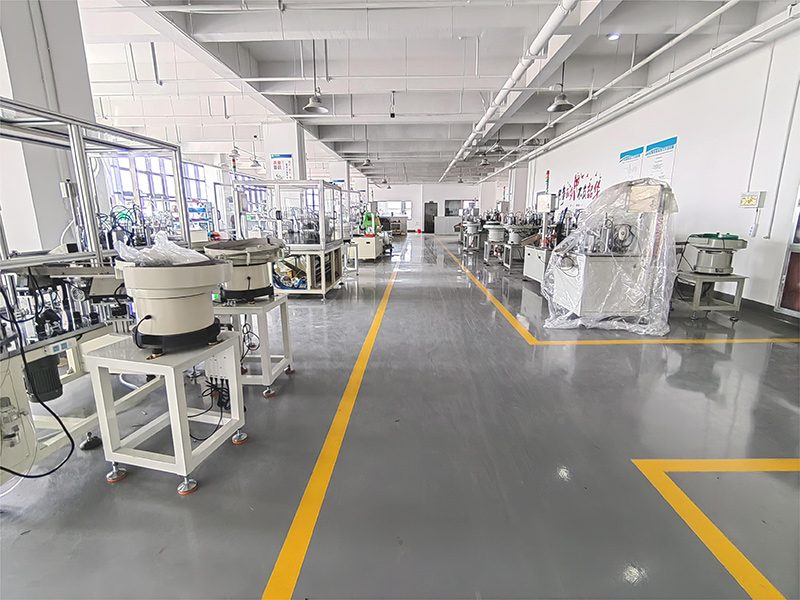
Physical infrastructure communicates operational priorities. Huagong Automation’s factory maintains distinct functional zones: technical department workspaces, multiple dedicated debugging areas, assembly areas, detection areas, processing areas, and shipping areas operating as separate stages rather than as an undifferentiated production floor.
This separation matters operationally. When debugging occupies its own physical zone, it cannot be compressed or bypassed under delivery schedule pressure. When detection areas function independently from assembly, inspection outcomes remain free from throughput-driven influence. Each zone boundary represents a deliberate quality control decision — a point where one stage of production completes fully before the next begins.
The discipline embedded in this layout transfers directly into the equipment shipped to clients. Machines that pass through structured debugging, independent detection, and systematic assembly processes before reaching the shipping area arrive with fewer post-installation adjustment requirements and shorter commissioning timelines.
How ISO 9001 and EU CE Certification Changed the Company’s Market Position
The 2020 EU CE certification and 2021 ISO 9001 certification marked the transition from domestic manufacturer to verifiable international supplier. The practical consequence was access: buyers in Europe, the Americas, and regulated Asian markets who previously could not approve an uncertified overseas supplier now had an auditable framework to work with. Between 2021 and 2024, international deployment scope expanded to include clients across Southeast Asia, the Middle East, and Eastern Europe — a geographic broadening that would not have been commercially viable without that certification infrastructure in place. Each subsequent delivery to clients in Europe, the Americas, Southeast Asia, and the Middle East strengthened the reference record. That record, in turn, reduces procurement hesitation for buyers evaluating the company for the first time — a compounding effect that becomes more valuable with each successful deployment.
The Service Architecture That Converts First-Time Buyers Into Long-Term Partners
A manufacturer’s service structure reveals its actual confidence in product durability. Huagong Automation’s after-sales model reflects that confidence at several levels simultaneously.
The after-sales model is structured around one measurable commitment: a 2-hour response SLA on support calls, with on-site engineer dispatch when remote resolution falls short. Core components — PLC systems and servo motors — carry a 2-year warranty; full equipment is covered for 1 year excluding consumables. For a production line running two shifts, this structure caps the financial exposure of a critical stoppage at a defined and manageable duration rather than leaving it open-ended. Clients in Europe and the Middle East with multi-timezone operations use video-based commissioning and remote diagnostics as the first-response tier before on-site dispatch is activated.
This architecture does not function as a service add-on. It functions as a retention mechanism — the operational reason why manufacturers who deploy one Huagong Automation machine frequently return for additional equipment rather than sourcing alternatives.
The Evidence That Defines Leadership — Beyond Self-Declaration
Manufacturing leadership in competitive markets is always a function of sustained capability rather than a single achievement or self-assigned title. Certified quality management, documented international deployments, cross-industry engineering track record, patent-backed product development, and a service model built on measurable commitments each represent an independent verification layer.
Huagong Automation’s trajectory from a 2014 founding through patent recognition, international certification, High-Tech Enterprise designation, and sustained global deployment demonstrates how each capability layer reinforces the next. The position the company holds today is the output of those compounding decisions — visible in the breadth of its product range, the structure of its factory, the credentials on its certifications, and the geography of its client base.
For product specifications and assembly solution consultations, visit https://www.hgautomachine.com/.
Ningbo Huagong Automation Technology Co., Ltd.
Ningbo Huagong Automation Technology Co., Ltd.
Legal Disclaimer:
EIN Presswire provides this news content “as is” without warranty of any kind. We do not accept any responsibility or liability
for the accuracy, content, images, videos, licenses, completeness, legality, or reliability of the information contained in this
article. If you have any complaints or copyright issues related to this article, kindly contact the author above.

Media gallery